Granada Hills attics often trap moisture because the warm Mediterranean summers create strong temperature swings between hot roof decks and cooler interior spaces, especially in homes built before updated ventilation codes. Testing begins with moisture meters and air sampling to locate hidden colonies behind insulation or along rafters without disturbing spores. In neighborhoods like Knollwood and near O'Melveny Park, older rooflines and limited ridge vents allow condensation to form on sheathing during mild winter nights, turning small leaks into larger mold colonies that spread into living spaces below.
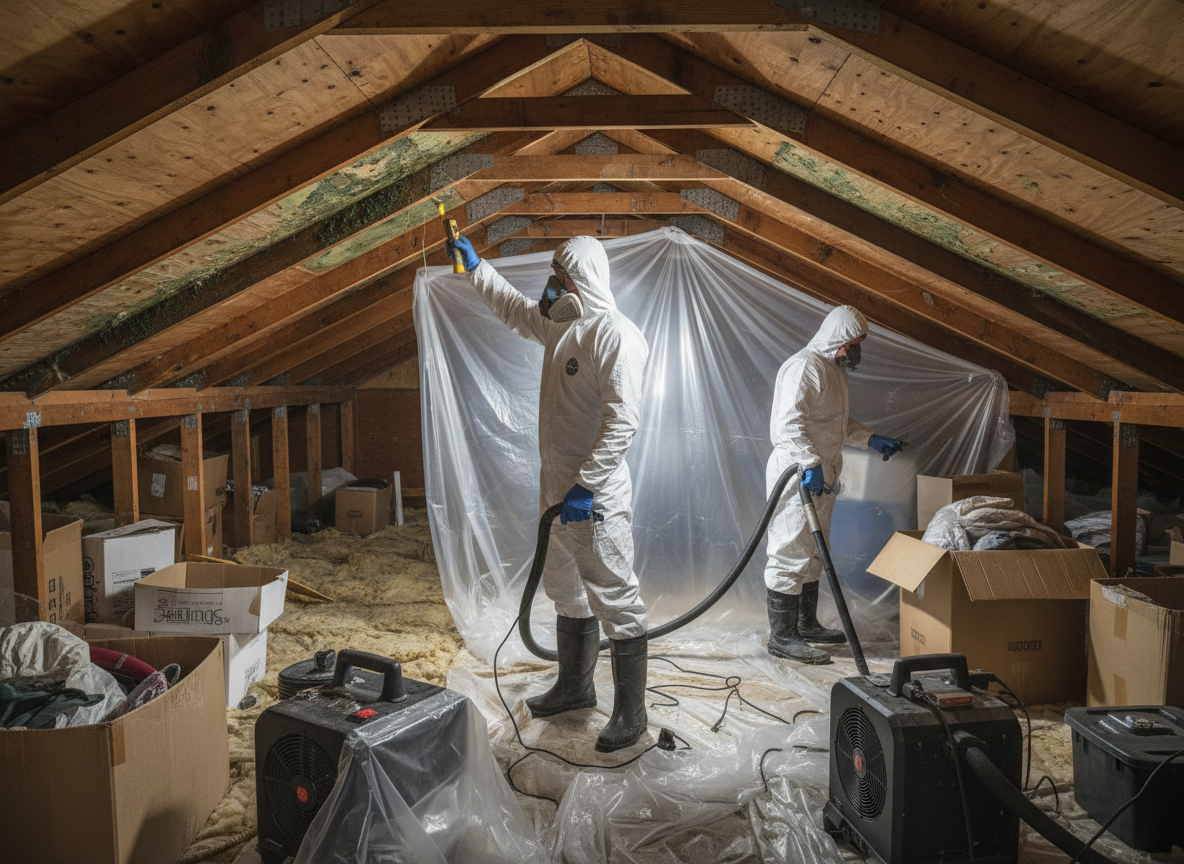
Removal work requires full containment with plastic barriers and negative air machines to keep spores from migrating into bedrooms or the Granada Hills Recreation Center vicinity homes. Technicians remove affected insulation and wood, then treat surfaces with EPA-registered antimicrobials before replacing materials. Los Angeles County rules on construction waste disposal mean all contaminated debris must be double-bagged and taken to approved landfills rather than standard dumpsters, adding steps that homeowners rarely anticipate.
Edge cases appear when mold reaches HVAC ducts routed through attics; these require separate cleaning or sealing to prevent recirculation into Porter Ranch and Mission Hills homes. Post-remediation verification includes a second round of air sampling to confirm spore counts have returned to outdoor baseline levels before any drywall or insulation reinstallation.
Technician insight
In Granada Hills, the thing that catches most people out with Attic mold testing and removal is how our mild winters still allow roof leaks to pool in older attics near Knollwood where original 1960s insulation has settled and blocked airflow, turning small drips into hidden colonies that only show up once summer heat drives odors downward.
Hidden Leak Behind Insulation
A Knollwood homeowner reported a persistent musty smell after a winter storm. Inspection revealed water tracking along rafters from a flashing failure near O'Melveny Park. We contained the space, removed saturated insulation, treated the sheathing, and installed additional ridge venting. Clearance tests passed and the odor did not return.
How it works
- 1
Initial Inspection
Technicians arrive 24/7 and use moisture meters plus borescopes to map water intrusion points in Granada Hills attics.
- 2
Air and Surface Sampling
Samples are collected and sent for lab analysis to identify mold types and concentrations before any disturbance.
- 3
Containment and Removal
Plastic barriers and HEPA filtration isolate the work area; affected materials are cut out and bagged for proper Los Angeles County disposal.
- 4
Treatment and Drying
Antimicrobial application follows, then dehumidifiers restore dry conditions to prevent regrowth in the hot summer climate.
- 5
Final Verification
Clearance testing confirms safe spore levels before the attic is returned to the homeowner.
Pricing
Cost depends on attic size, mold extent, and whether HVAC ducts are involved; upfront quotes provided after inspection.